 English
Keele-led project to monitor crop diseases spreading in Europe
A four-year Keele-led study will examine bacterial plant diseases affecting crops in parts of Europe and develop tools to help UK growers assess future risks.
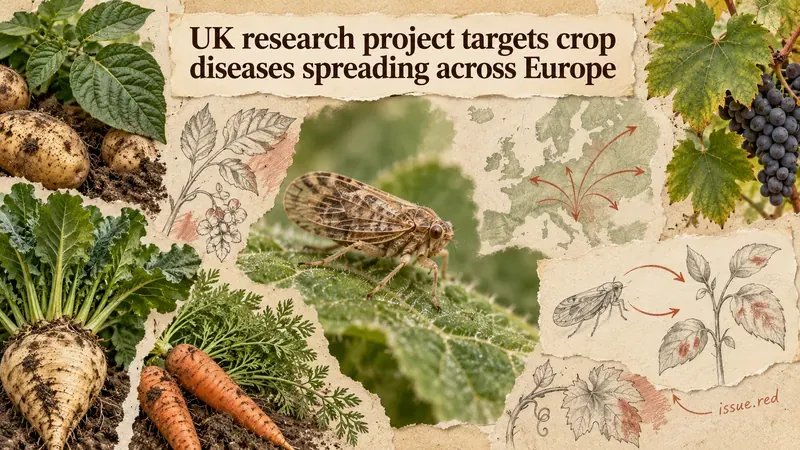
A four-year research project led by Keele University will investigate bacterial plant diseases spreading across parts of continental Europe and help UK growers prepare for possible future outbreaks. The project focuses on diseases carried by planthoppers; the insects are present in the UK, but the diseases themselves are not currently believed to be established here.
Three key points
- The project, led by Professor James Bell at Keele, will study a group of five bacterial plant diseases that can be transmitted by two planthopper species.
- Researchers will assess risks to crops including potatoes, sugar beet, carrots and grapevines, and develop tools for understanding, monitoring and assessing risk.
- The Keele-led study is one of 18 research projects receiving a share of more than £54 million from UK government and UK Research and Innovation partners.
Why the project is being launched
Keele University announced the four-year project on 7 October. The university says the diseases are affecting crops in parts of continental Europe, reducing yields and quality, while the planthopper species that can spread them are already present in the UK. The diseases are currently thought to be absent from the country.
The work will examine two planthopper species capable of carrying five bacterial diseases between crops and wild plant hosts. The team plans to study biological, ecological, economic and social factors, then develop practical tools to improve monitoring and risk assessment. Keele says the project will also engage with the Department for Environment, Food and Rural Affairs (Defra) on plant-health policy and risk assessment.
Eight research organisations involved
Professor James Bell is leading a consortium that includes the Animal and Plant Health Agency, Fera Science, Rothamsted Research, and the universities of Exeter, Gloucestershire, Warwick and York, alongside Keele. The project is intended to help farmers, growers, industry and policymakers prepare before the diseases become established in the UK; it does not report a current UK outbreak or a completed control method.
UKRI lists the E-Prep II project among 18 new research and innovation projects backed by more than £54 million in public investment. The wider programme also covers epidemic preparedness, antimicrobial resistance and veterinary vaccines. Keele’s project is the part focused on emerging bacterial threats to crops.
Sources
Sources
- New research aims to protect UK crops from diseases spreading across Europe — Keele University
- UK government and UKRI invest £54m to tackle biosecurity threats — UK Research and Innovation (UKRI)