 English
England eases planning rules for home EV charging across pavements
Rules effective from 21 October remove a planning step for qualifying cross-pavement charging schemes. Council approval and other requirements still apply.
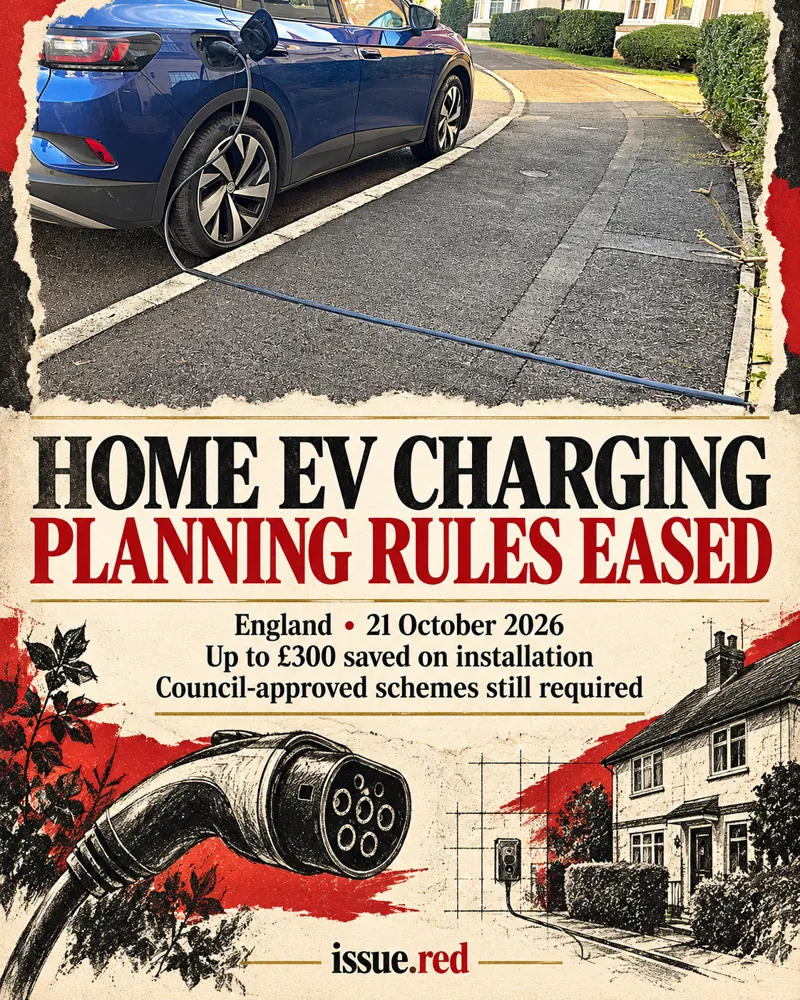
Households in England without a driveway have a simpler route to charging an electric car from their home electricity supply, after new planning rules took effect on 21 October. The change removes the need for planning permission for qualifying cross-pavement installations, with the Department for Transport estimating savings of up to £300 on installation.
A planning saving, with conditions
Cross-pavement channels carry a charging cable between a home and a car parked on the street. Removing the planning application does not make the charger or its installation free, nor does it give residents permission to carry out pavement works independently.
Cornwall Council’s guidance explains that the new Class F permitted development right applies where the chargepoint forms part of an approved local authority scheme. The channel must be installed by, on behalf of, or with the authorisation of a highway authority.
The right does not cover channels within a scheduled monument site, the curtilage of a listed building or a conservation area. Residents should check their property and their council’s scheme before arranging work.
Check licences before installation
Cornwall also says an S178 licence is needed to install an EV channel and warns against trailing a cable across the pavement. Its guidance states that building regulation approval is required. Households elsewhere in England should check the relevant highway authority’s process, rather than assume the national planning change is the only approval they need.
Separate proposals for renters and covered car parks
The government has also opened two consultations, with responses due by 16 December 2026. One considers improving charging access for tenants and leaseholders, including how landlords handle requests and whether mandatory requirements should make refusals harder.
The other considers building regulation changes for charging infrastructure, including new and refurbished covered car parks. These are proposals for consultation, separate from the planning change already in force; they do not yet establish a universal new entitlement for renters.
The planning change reported here applies to England. The department’s projected savings depend on the installation and electricity arrangements and are not a guaranteed saving for every household.
Sources
- Drivers to save up to £300 when installing EV chargers at home — Department for Transport
- Electric Vehicle (EV) charging points — Cornwall Council